
Why Underinsured Motorist Coverage Matters for Missouri Drivers
Missouri requires only $25,000.00 in liability coverage and one driver in five carries none. Underinsured motorist coverage is the optional, inexpensive line on your own policy that pays when the at-fault driver cannot.

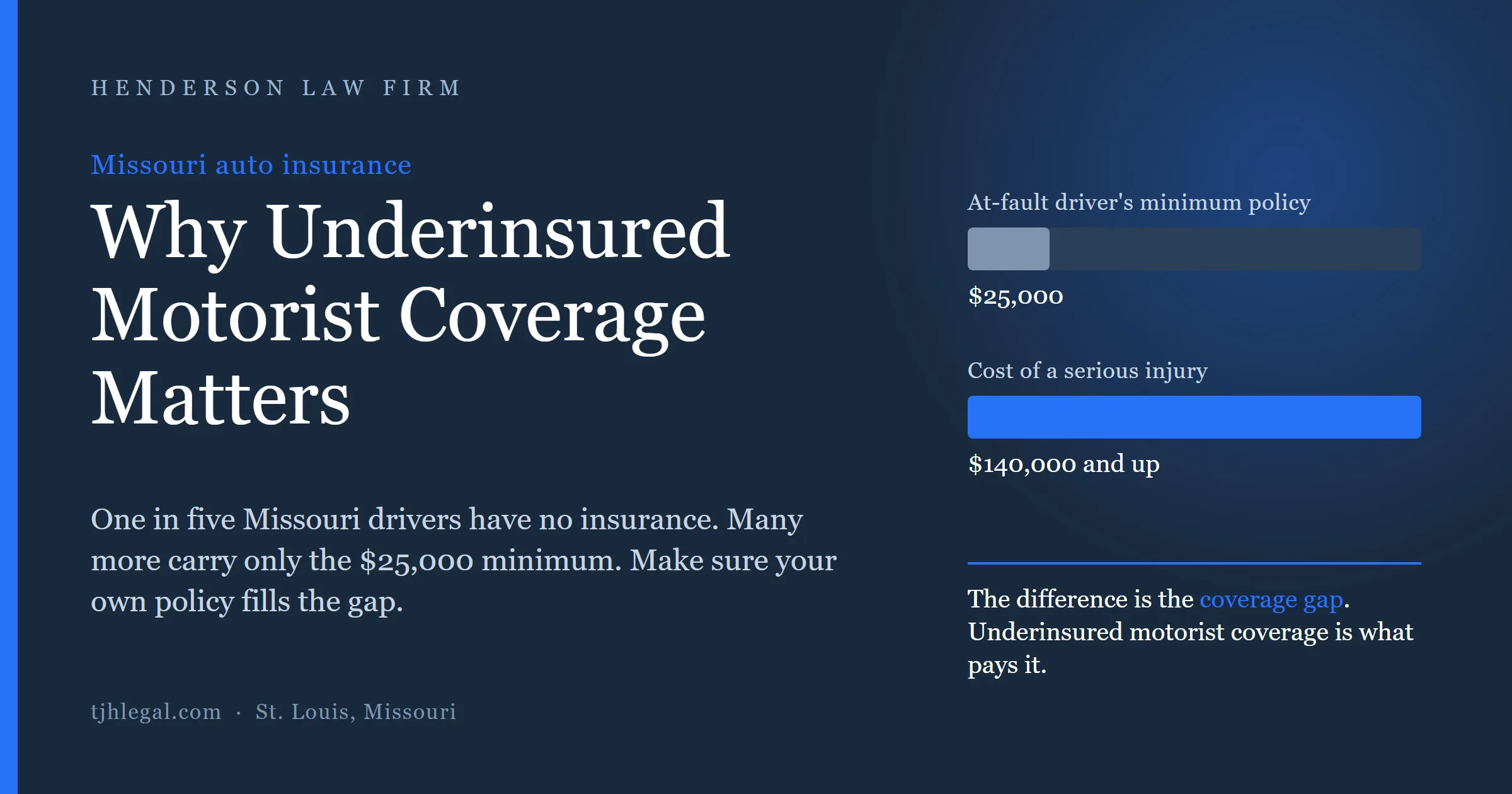
Most Missouri drivers carry the liability insurance the state requires and assume they are protected. They are protected against the wrong thing. Liability coverage pays the people you injure. It pays nothing when someone else injures you. For that, you depend on the other driver’s policy, and in Missouri the other driver’s policy is often the legal minimum: $25,000.00 per person. A hospital can bill that in the first night.
Underinsured motorist coverage, usually called UIM, is the part of your own policy that fills the gap between what the at-fault driver carries and what your injuries are worth. It is optional in Missouri, it is cheap relative to what it does, and it is the coverage we most often wish a client had bought.
What Missouri Requires, and What It Does Not
Missouri’s financial responsibility law sets the minimum liability limits at $25,000.00 for injury to one person, $50,000.00 for injury to two or more people in one accident, and $25,000.00 for property damage (Section 303.020). Those numbers have not kept pace with medical costs. A fractured wrist with surgery, a few months of physical therapy, and lost wages can exhaust a $25,000.00 policy before anyone talks about pain, scarring, or a permanent restriction.
Missouri also requires every auto liability policy to include uninsured motorist coverage at those same minimum limits (Section 379.203). Uninsured motorist coverage, called UM, applies when the at-fault driver has no insurance at all, or in a hit-and-run. It is a real protection, but it is capped at $25,000.00 unless you buy more.
What Missouri does not require is underinsured motorist coverage. UIM applies when the at-fault driver has insurance, just not enough. No statute makes an insurer offer it, and no statute makes you buy it. Plenty of drivers who think they are “fully covered” have none.
How Often the Other Driver Is the Problem
The Insurance Research Council estimates that 20.7% of Missouri drivers were uninsured in 2023, the sixth-highest rate in the country and well above the national estimate of 15.4%. That figure counts only drivers with no insurance. Add the drivers who carry the $25,000.00 minimum, and the share of at-fault drivers who cannot pay for a serious injury is far larger. On a St. Louis highway, the odds that the car that hits you is uninsured or minimally insured are not small. They are closer to a coin flip than most people would guess.
A Worked Example
Suppose you are rear-ended on I-64, you need a cervical fusion, and your medical bills alone reach $140,000.00. The at-fault driver has the state minimum. Here is how the money works with and without UIM.
Without UIM: the at-fault driver’s insurer pays its $25,000.00 limit. Your health insurer pays some of the bills and then asserts a lien on your recovery. The at-fault driver personally owes the rest, and a driver who bought minimum limits almost never has assets worth pursuing. You absorb the difference.
With $250,000.00 in UIM: the at-fault driver’s insurer pays $25,000.00. Your own insurer then pays up to its UIM limit for the rest of your damages, subject to the policy’s set-off terms discussed below. The claim is still a fight, since your own insurer evaluates your injuries the way any insurer does, but there is now a policy large enough to pay for what happened to you.
Read the Limit Carefully: Set-Off and Stacking
UIM policies are not all written the same way, and the difference matters more than the premium. The two terms to understand are set-off and stacking.
Set-off means the insurer subtracts what the at-fault driver paid from your UIM limit. If you carry $50,000.00 in UIM and the at-fault driver pays $25,000.00, a set-off policy pays at most $25,000.00 more, not $50,000.00 on top. The Missouri Supreme Court enforces set-off clauses when the policy language is clear, as it was in Rodriguez v. General Accident Insurance Co., 808 S.W.2d 379 (Mo. banc 1991). When the policy promises one thing on the declarations page and takes it back in the fine print, Missouri courts read the ambiguity against the insurer, which is what happened in Ritchie v. Allied Property & Casualty Insurance Co., 307 S.W.3d 132 (Mo. banc 2009). Those cases are decided one policy at a time, and the better plan is to buy a limit high enough that set-off does not leave you with nothing.
Missouri gives one statutory floor here. Under Section 379.204, UIM coverage with limits below twice the state minimum is construed to apply in excess of the at-fault driver’s liability coverage. In plain terms, a small UIM limit cannot be wiped out entirely by a set-off. Above that floor, the policy language controls.
Stacking means combining the UIM limits on more than one vehicle, or more than one policy, for a single accident. Some policies allow it, many forbid it, and Missouri courts enforce an anti-stacking clause if it is unambiguous. If you insure three cars, ask whether your UIM limits stack. The answer changes the value of the coverage by a multiple.
What UIM Costs and What to Buy
UIM is usually one of the least expensive lines on an auto policy because it only pays when someone else is at fault and underinsured. Raising it from $50,000.00 to $250,000.00 typically costs a fraction of what the same increase in liability coverage would. Insurers rarely volunteer it, and the online quote tools default to low limits or none.
A reasonable rule: carry UM and UIM limits at least equal to your liability limits, and carry liability limits of $100,000.00 per person or more. If you can afford $250,000.00 or $500,000.00, buy it. An umbrella policy adds liability protection but often does not add UIM unless you ask for it specifically, so check.
Also confirm who the coverage follows. Your UIM generally covers you and your household family members as drivers, passengers, pedestrians, and cyclists, not just when you are behind the wheel of the insured car. That is a broad protection for a low premium.
If You Have Already Been Hurt
If you were injured by a driver with minimum limits, do not accept the at-fault insurer’s $25,000.00 without first looking at your own policy and the policies of any relative you live with. UIM claims have their own notice and consent requirements. Most policies require you to get your own insurer’s written permission before settling with the at-fault driver, because the settlement extinguishes your insurer’s right to go after that driver. Settling without consent can forfeit the UIM claim. That is a trap, and it is easy to step in if the first offer arrives before you have talked to anyone.
Henderson Law Firm’s personal injury practice handles underinsured and uninsured motorist claims across St. Louis City and County, including the coverage disputes over set-off and stacking that decide what a policy actually pays. We review every available policy before advising a client to settle with anyone.
Takeaway
Liability insurance protects other people from you. Underinsured motorist coverage protects you from other people, and in a state where one driver in five carries no insurance and many more carry the minimum, it is the coverage most likely to decide whether a serious injury is paid for. It is optional, inexpensive, and worth a five-minute call to your agent. Ask for UM and UIM limits that match your liability limits, and also be sure to ask whether the policy sets off and whether it stacks.
